How to Choose the Best Print on Demand Companies in Canada 2026
When it comes to publishing, some authors think that they have to print hundreds of copies and hope they sell. Well, it doesn’t work like that anymore.
Now, authors are commonly choosing print on demand for book printing in Canada. This means that you can publish your work with less upfront risk and avoid storing boxes of unsold books. Isn’t that amazing?
But with so many print on demand companies available, choosing the right one can feel confusing. You have to focus not only on price and print quality but also on distribution and shipping.
Let’s understand how you can pick the right print on demand Canadian company in 2026.
Why Are More Authors Opting for Print on Demand Companies?
Let’s begin our guide by understanding why more authors are opting for print on demand (POD) companies.
Well, authors are more commonly choosing print on demand companies due to lower upfront investment and less risk of unsold inventory.
In addition to this, it provides authors with easier access to different formats.
● Lower Upfront Investment
To begin with, one of the key benefits of print on demand is that authors don’t need to order a huge batch of books before publication.
You may not know this, but traditional book printing in Canada often requires authors to pay for a large quantity upfront. And this can be difficult if you are publishing your first book.
But print on demand works a bit differently. A copy can be produced when a customer places an order. This means authors can avoid spending a large amount of money on inventory that may sit in storage.
If you are a new writer, then this lower financial commitment can make self-publishing feel much more achievable for you.
● Less Risk of Unsold Inventory
Imagine ordering 500 books and selling only 150. You would still have hundreds of copies sitting somewhere. Besides taking up space, those books represent money that has already been spent.
But print on demand companies easily solve this issue. This means you can produce books based on demand rather than entirely on predictions.
However, this doesn’t eliminate every publishing cost. But it can make inventory management much easier.
● Easier Access to Different Formats
On top of that, modern POD companies can offer more than a basic paperback. You can access not only hardcover books and different trim sizes but also colour printing and other options.
However, you must keep in mind that these options may vary depending on the provider.
This flexibility is quite valuable because every book is different. A novel may need a simple paperback, and a children’s book may benefit from vibrant colour printing. An art book, on the flip side, may require a premium format.
The right POD company should give you enough choices to match your book rather than forcing every title into the same format.
How Can You Pick the Finest Print on Demand Companies in Canada?
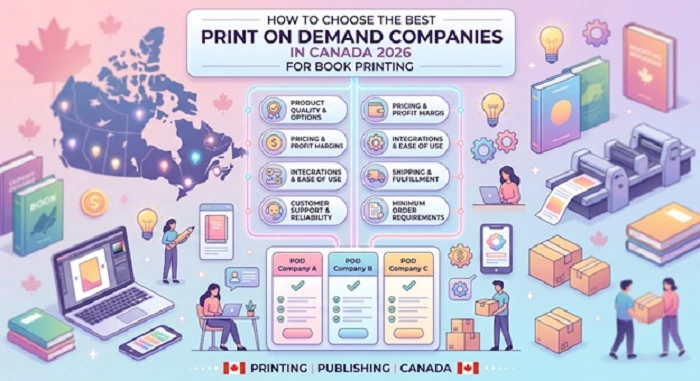
To choose the best print on demand Canadian companies in 2026, you should carefully compare print quality. Also, examine pricing and author royalties of various companies.
On top of that, you must not only check distribution and evaluate customer support but also review shipping and production times.
● Compare Print Quality Carefully
First and foremost, you must remember that price should never be your only deciding factor for book binding in Canada. A book is a physical product, so its quality matters a lot.
You must look not only at the paper options and cover finishes but also at the binding methods, colour reproduction, and available sizes. You should also order a proof copy before making your book available to readers.
This is because a proof allows you to see how your cover looks in real life. You can also inspect not only the page alignment and colours but also typography and binding.
This step can help you prevent any expensive mistakes later.
● Examine Pricing and Author Royalties
In addition, you have to review the pricing and author royalties offered by different POD companies.
Every POD company has its own pricing structure. Some may have low setup costs but higher printing charges. Others may offer different royalty arrangements or distribution fees. But you shouldn’t compare companies based on one number.
Instead, you can calculate the complete cost of producing and selling your book. Besides that, you look not only at the printing cost and distribution charges but also at the shipping expenses and your expected royalty.
● Check Distribution
But the question is, where will readers actually find your book? Some authors only want to sell through an online marketplace. However, others want their books available not only through bookstores and libraries but also through online retailers and their own websites.
You must remember that distribution options vary between POD providers. Therefore, you need to check which retailers and markets each company can reach.
On top of that, Canadian authors should also think about international readers. If you expect customers outside Canada, you must find out how the company handles international fulfilment and shipping.
● Review Shipping and Production Times
Apart from that, shipping is easy to overlook until a customer is actually waiting for your book. Before choosing a POD provider, you have to check estimated production times and delivery options.
You must look for information about where books are printed and how orders are fulfilled.
Canadian customers may benefit from local or regional fulfilment. This is because books don’t have to travel as far.
You should also check shipping prices. A low book price can quickly become less attractive when delivery charges are added.
If you are researching print on demand books in Canada, always consider the final cost and delivery experience from the reader’s perspective.
● Evaluate Customer Support
Last but not least, publishing a book involves more than uploading a manuscript. You have to not only format files and create a cover but also set pricing, order proofs, make corrections, and manage your published title.
That is why the platform itself matters a lot.
You must look for a POD company with clear file specifications and an easy-to-use dashboard. Helpful upload tools can also allow you to identify problems before your book goes into production.
Customer support is equally important. If something goes wrong with your files or an order, you want to know that help is available.
To choose the right one, you should read recent reviews from other authors. Besides that, you must pay attention to repeated comments not only about support and production quality but also about order accuracy and communication.
Most Asked Questions
What is meant by a print on demand book company?
Ans. A print on demand (POD) book company is actually a publishing and manufacturing service. It prints a single copy or a small batch of a book only after a customer or author places an order.
Is print on demand a good option for first-time authors?
Ans. Yes, print-on-demand is an excellent option for first-time authors. This is because it removes the high financial risk of bulk printing and allows books to be printed individually only when a customer places an order.
How much does book printing in Canada cost?
Ans. Book printing in Canada generally costs between C$2.50 and C$15.00+ per book. However, the actual cost depends largely not only on your production method and page count but also on order volume.
Let’s Bring It All Together!
So, that’s everything you need to know!
Print on demand has gained widespread acclaim among Canadian authors. The reason for this popularity is not only the lower upfront investment and less risk of unsold inventory but also the easier access to various book formats.
However, you must ensure that you choose the best print on demand company for your book printing in Canada. To do so, you must not only compare print quality carefully but also examine pricing and author royalties.
In addition to this, you need to check distribution and evaluate customer support. And don’t forget to review shipping and production times.

Mary Smith is working as managing director at Book Print Canada, She is very focused on digital and offset printing techniques, serving clients with exceptional results. Her team of experts is well-equipped with the latest trends and also prints books for large-scale businesses.