
How Much Does It Average Cost To Print A Book?
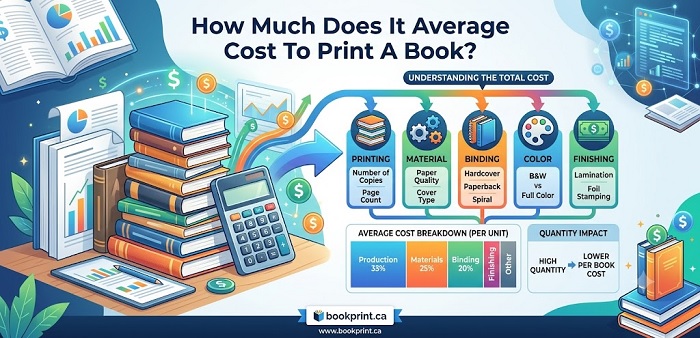
There is not a single answer to this question. The cost of print a book depends on several factors, including the book’s format, paper quality, page count, print quality, and printing method. The production cost of a 400-page hardcover print will be different from the cost of a 150-page paperback print. Once you understand budgeting and the workings of these costs, it will be easier for you to set realistic prices, anticipate unexpected expenses, and protect your profit margins. This blog is a friendly guide to the average cost of printing a book with careful planning.
Printing a book is one of the biggest cost of production for authors and publishers. Understanding printing costs is crucial for making informed business decisions, whether you are releasing your first self-published novel or managing several titles for a small publishing company.
The Average Book Printing Cost In Canada
The cost of book printing Canada can range from just a few dollars per copy to over twenty dollars, depending on the specifications. The exact pricing varies between printers, but it is important to understand typical industry ranges to estimate your budget more accurately.
- Paperback Book
Paperback book production is frequently the most economical choice for authors and publishers. A basic 200–300 page black-and-white paperback will normally cost between $3 and $12. For example, using a print-on-demand service to produce a 250-page novel will cost you between $6 and $9 per copy. The price will increase if the same book is printed in a larger offset print run. The ultimate cost is also influenced by a few additional elements, such as paper weight, cover gloss, and trim size.
- Hardcover Book
Hardcover books may increase cost due to the requirement of additional materials and more complex production processes. A simple hardcover book typically costs between $12 and $30 per copy. Adding some premium features like foil stamping, dust jackets, specialty finishes, and cloth covers can increase prices even higher.
Since customers are expected to pay a high retail price for hardback formats, most publishers only reserve hardcover editions for novels with great sales potential or premium placement.
- Cost Per Book Based On Print Quantity
Print quantity directly affects the cost of each book. If you print 100 copies of a paperback, it might cost you $7 to $10 per unit. If you increase this number to 1,000 or 2,000 copies, then the cost will drop to $3 t $6 per book.
This is merely because the setup and manufacturing costs are split over a greater number of copies. Because of this, the cost per unit will decrease as you print more.
- Typical Cost Ranges Based On Page Count
The factor of page count directly impacts the printing cost because adding more pages will require more paper and ink. If a 100-page paperback book will cost you $3 to $6 per copy, then a 200- to 300-page book may require $4 to $12 per copy. A book with 400 pages will increase the cost more, as it depends on the format and printing specifications. A little increase in page count will also affect the production cost, especially for large bulk production.
Factors Affecting Book Printing Cost
The decision of each production influences the final bill for printing. Understanding the following factors will allow the publishers to balance the quality, readers’ expectations, and budget requirements.
- Book size and trim dimensions: Large books or custom sizes may require a higher cost due to additional setup, while standard trim sizes are more economical as the printers can produce them efficiently.
- Number of pages: Page count is an important key driver. The more pages that are added, the more paper and ink will be required, and even stronger binding will be needed. Publishers often review standard layouts and avoid excessive increases in page count.
- Paper type and quality: The choice of paper quality directly affects production costs. If you use standard interior paper, it will be much more affordable, but choosing high-quality paper or premium stocks will significantly increase the prices. Illustration and photography books often require high-quality paper, which will result in high printing costs.
- Color vs. black-and-white printing: Color printing books are more expensive than black-and-white printing. A novel that can be printed in black and white will be affordable, while a children’s book should have color printing, which is high in cost. Publishers must evaluate what their book needs before committing to the more expensive option.
- Binding options and cover finishes: The choice of book binding affects the durability and cost. Perfect spiral binding book printing is cost-effective and best for paperback, while hardcover is perfect for durability, but it can increase production cost. Adding cover finishes like gloss coating, matte lamination, embossing, and foil stamping can elevate the visual appearance but add to the final cost.
Planning a Realistic Book Printing Budget
Printing is just one part of the publishing cost. If you are setting a realistic budget, you should consider the entire journey from manuscript to final, finished production.
- Calculate The Total Expense Of The Production
Printing a book is just a piece of a puzzle. Book production requires investment for editing, proofreading, formatting, cover design, ISBN registration, and marketing. Considering and reviewing the whole expense can prevent budget shortfalls later.
- Consider Shipping And Distribution Cost
Books are heavy, and the shipping cost will be impacted. Include your transportation expenses in your financial planning from the start, whether you are sending to retailers, customers, or warehouses.
- Set A Profitable Book Price
Your retail price should cover all the production costs and leave room for profit. When publishers determine the final pricing, they account for retailer discounts, marketing expenses, and distributor fees.
- Prepare For Future Reprints
A successful book requires additional prints. Ensure to prepare for a reprint to maintain inventory levels and avoid rushed production that increases cost.
- Balance Quality With Profit Margins
Readers will appreciate it if the quality of your book is good and it increases profitability. Your goal should be to create a product that meets the expectations of the readers, but it should also maintain healthy margins.
Frequently Asked Questions
- How much time does it take to print a book?
The timeline to print a book depends on the order size and the printer. Print-on-demand may be produced within a few days, while offset printing may take several weeks, especially if it includes shipping.
- Do international book printing companies offer lower costs?
Overseas prints often provide lower print cost per unit, particularly for large runs. Most authors and publishers also consider custom fees, shipping costs, and production timelines when comparing these options.
- Can I order a sample copy before printing a full run?
Most of the production houses provide proof copies or sample prints. It can help you to identify the design, quality, and formatting issues before committing to larger runs.
Final Thoughts
The cost of book printing depends on multiple factors, including the page count, paper quality, format, print quantity, binding, and production method. Considering a paperback may cost you only a few dollars, but a hardcover can cost significantly more. It is crucial to understand these variables to help authors and publishers to make informed decisions for production, pricing, and distribution.
The most successful publishing projects begin with realistic budgeting. When you evaluate printing costs alongside editing, design, shipping, distribution, and marketing expenses, you gain a clearer picture of your total investment. Careful planning allows you to maintain quality, protect profit margins, and build a publishing strategy that supports long-term success.

Mary Smith is working as managing director at Book Print Canada, She is very focused on digital and offset printing techniques, serving clients with exceptional results. Her team of experts is well-equipped with the latest trends and also prints books for large-scale businesses.